
A custom wedding invitation designed to reflect the atmosphere of a relaxed picnic-style wedding celebration. The piece mailed flat in a standard envelope, then unfolded into a three-dimensional picnic basket filled with interactive themed details. The project combined structural paper engineering, storytelling, and production constraints to create a dimensional invitation that remained practical to print, assemble, and mail.

Vision
A Picnic, Not a Gala
We wanted the wedding to feel more like a relaxed family reunion picnic in the park than a traditional formal wedding. The goal wasn’t elegance or ceremony for its own sake. It was creating an atmosphere that felt warm, casual, welcoming, and personal.
The invitation needed to communicate that experience immediately. Rather than relying on formal stationery conventions, the piece was designed to feel playful, interactive, and nostalgic, setting the tone for the celebration before guests even arrived.
The starting point came from our real picnic basket, which had become part of our Shakespeare in the Park dates together. From there, the challenge became translating that emotional connection into something functional, dimensional, and mailable while carefully balancing production complexity, assembly practicality, and mailing limitations.


Role & Scope
Designing the Object
Responsibilities included:
- Concept Development
- Custom Dieline Creation
- Structural Prototyping
- Print Production Setup
- Digital Die Cutting
- Assembly Planning
Process
Engineering the Basket
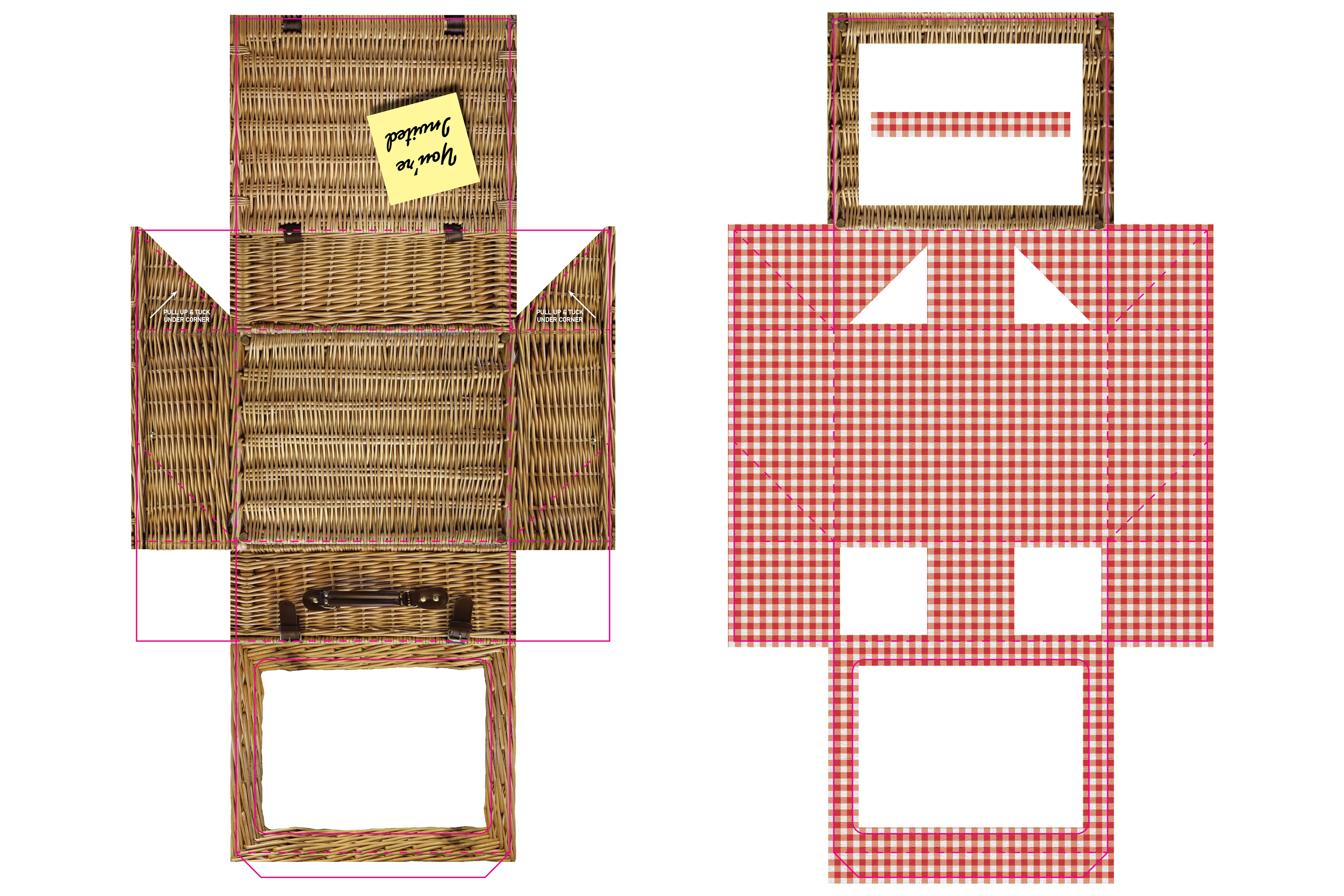
The project began with custom dieline exploration and physical paper prototypes to determine how the basket could collapse flat for mailing while still unfolding into a stable dimensional form once opened. Packaging structures such as letterhead boxes became important references because their folding mechanics balanced structure, compact mailing formats, and intuitive assembly.
Once the structural approach was established, I photographed our real picnic basket from multiple angles to use as the foundation for the visual design. The photographs were incorporated directly into the panel artwork so the woven textures, straps, and hardware details aligned naturally with the physical structure of the piece, while elements like the gingham lining were digitally recreated to maintain clarity and readability at the smaller scale of the invitation.
Key Decisions
Designed for Discovery
- The structure was engineered to fold flat into a standard mailing envelope, balancing dimensional interaction with practical assembly, mailing, and storage requirements.
- The invitation was structured as a sequence of discoveries rather than a single flat information layout, allowing the interaction to feel playful and exploratory as the basket unfolded.
- Realistic construction details including woven textures, plate holders, straps, and layered inserts helped reinforce the illusion of the invitation as a miniature functional picnic basket rather than simply picnic-themed graphics applied to paper.
- The basket exterior carried significant visual texture and detail, so the typography was intentionally restrained to maintain readability without overwhelming the composition.

Challenges
Making a Pop-Up Object Behave Like Standard Mail
I wanted the invitation to feel like a physical object rather than a traditional flat card, but dimensional mail pieces quickly become expensive, oversized, or difficult to produce. The challenge became finding a way to create that same sense of interaction and surprise while still remaining compact, durable, and practical to mail.
That goal shaped nearly every structural decision throughout the project.
The final piece ultimately mailed within USPS first-class limitations using a standard 2 oz stamp, a common threshold for invitation suites containing multiple inserts and RSVP materials. The finished structure landed just beneath the allowable thickness limit, requiring careful control over paper stock, folds, and assembly tolerances to ensure the dimensional interaction of the basket remained consistent and mailable across the full set of invitations.
A Chain of Interdependent Constraints
Because nearly every production variable was interconnected, the project became a tightly constrained dimensional system where one sizing decision directly affected the next. The operational boundaries of the piece became dependent on the following relationships:
- Minimum folded invite size was established by the smallest standard mailable RSVP envelope.
- Maximum folded invite size was established by the largest mailing envelope still eligible for USPS first-class rates.
- Unfolded layout was constrained by a 12″ × 18″ press sheet and the maximum cutting width supported by the home cutting setup.
- Folded structure needed to remain durable enough for mailing while still unfolding naturally into a dimensional form.
- Envelope sourcing prioritized standard formats over custom ordering.
By the end of development, there was virtually no remaining size wiggle room in the project. The RSVP envelope dimensions, folded basket size, mailing envelope limitations, USPS first-class requirements, press sheet layout, cutter limitations, and folding mechanics had all become tightly dependent on one another. Even small dimensional changes could force revisions across the entire structure.
Unfolding the Experience
The invitation was organized as a layered picnic experience rather than a single flat information card. Essential event details appeared first on a ‘napkin’ insert, while supporting elements were distributed throughout the basket to mimic unpacking a real picnic setup.
The RSVP card was designed as a “plate” stored beneath the lid, secured by a faux leather strap similar to the plate holders found inside real picnic baskets. The format helped tie the RSVP interaction into the larger picnic experience while reinforcing the illusion of the basket as a functional object.
Repeated prototyping helped refine how the structure opened, folded, and held its shape until the basket could reliably collapse flat for mailing while still unfolding naturally once opened.
Outcome
A Keepsake in the Mail
The final invitation transformed from a flat mailer into a dimensional picnic basket that immediately communicated the tone of the wedding. The interaction felt playful and personal while still remaining practical to assemble, mail, and use.
By balancing structural engineering with realistic visual details, the piece functioned as both an invitation and a keepsake object. Guests responded enthusiastically to the experience, and many kept the basket long after the wedding rather than discarding it like traditional stationery.
Client: Walsh-Mesmer Wedding
Role: Concept Development | Production Design | Packaging Design
Date: April 2019